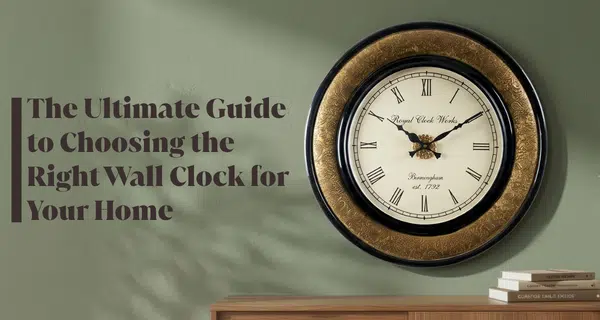
How to Choose Decorative Clocks for Your Home: A Guide to Meaningful Styling
A wall can be beautifully furnished and still feel as though something is missing.
Perhaps there is a console beneath it, a comfortable sofa in front of it and carefully chosen accessories around the room. Yet the wall itself has no visual anchor. In such spaces, a clock can do something that ordinary accessories often cannot: bring together function, proportion and personality in a single design element.
That is why decorative clocks for home interiors deserve to be considered as more than practical timepieces. A designer clock can act almost like wall art, introduce a contrasting material, fill an awkward area or establish the visual character of an entire corner.
The question, therefore, is not simply Which clock tells the time?
It is:
What should this clock contribute to the room?
First Decide What You Want the Wall to Say
Before looking at shapes, finishes or numbers on a clock face, look at the wall itself.
A large blank wall above a sofa may need a substantial visual anchor. A narrow wall beside an entryway may benefit from something more restrained. A study may call for a design that feels structured and understated, while a living room can accommodate something more expressive.
This is where the idea of a clock as a focal point becomes useful.
Interior designers commonly use a focal point to establish where the eye should naturally land first. Scale, colour, artwork, architecture and decorative objects can all create emphasis within a room.
A clock can perform that role particularly well because its circular or architectural form immediately gives a wall a defined centre.
So instead of beginning with “What style of clock do I like?”, begin with:
“What does this wall currently lack?”
It might need:
- height
- width
- contrast
- symmetry
- warmth
a stronger focal point
or simply one object with enough presence to hold the wall together
That answer should influence your clock choice.
When Size Becomes Part of the Design
One of the easiest ways to make a clock look disconnected from its surroundings is to ignore scale.
A beautiful clock can still feel wrong if it is too small for the wall or too large for the furniture beneath it.
Think about the relationship between the clock and everything around it rather than judging its dimensions in isolation.
Above a console
A clock positioned above a console should have enough visual presence to relate to the width of the furniture beneath it. A very small clock floating above a broad console can make both pieces feel disconnected.
A larger design can instead create a clear vertical relationship between the furniture and the wall.
Above a sofa
A substantial wall often needs a stronger decorative element. This is where statement clocks for living room spaces can work particularly well.
An oversized clock can become the central visual element, while the sofa, cushions and surrounding decor act as supporting elements.
On a narrow wall
Here, proportion becomes more important than simply choosing the biggest design available. A medium-sized clock with an interesting frame or layered construction can provide enough character without overwhelming the wall.
Recent design guidance around scale makes a similar point: proportion is not merely about whether an object physically fits; it affects how balanced the entire composition feels.
Let the Clock and Wall Art Have Different Jobs
One of the most interesting ways to use decorative wall clocks is alongside artwork.
But there is an important distinction between coordinating and matching.
You do not necessarily need a clock and artwork in identical colours or materials. Instead, look for a relationship between them.
For example:
A dark metal clock + warm-toned artwork
The clock can provide structure while the artwork introduces colour and softness.
A wooden clock + botanical or nature-inspired artwork
The shared natural character creates a visual connection without making the arrangement overly coordinated.
A metallic clock + neutral artwork
The clock can introduce a subtle reflective element against an otherwise quiet wall.
A sculptural clock + minimal artwork
When the clock itself has a strong silhouette, keeping the artwork simpler allows both elements to remain visible.
The broader principle used in artwork styling is to consider scale, colour, placement and the role of the focal point rather than treating every wall element independently.
This approach makes the wall feel curated rather than decorated item by item.
The Material Changes the Mood
The material of a clock can influence the atmosphere of a room just as much as its shape.
Metal clocks
Metal brings structure and definition.
Metal wall clocks can work especially well in contemporary interiors, neutral living rooms and spaces that already contain metal details in lighting, furniture or accessories.
Black metal can create graphic contrast. Gold-toned metal can introduce warmth. More intricate metal forms can give a plain wall an almost sculptural quality.
Wooden clocks
Wood introduces warmth and visual softness.
A wooden clock can sit comfortably alongside timber furniture, earthy colours, neutral walls and Indian-inspired interiors. It can also make a modern space feel less stark.
This is particularly useful when the room already contains hard surfaces such as stone, glass or metal.
Mixed-material clocks
Mixed-material designs offer another possibility: they connect different elements already present in the room.
A combination of wood and metal, for example, can visually bridge a wooden console with metal lighting or hardware.
Rather than trying to make every finish identical, use the clock as the element that connects two existing materials.
Designer clocks
A designer clock can take a more expressive approach.
Instead of blending quietly into the wall, it can become an object that people notice. This makes it particularly suitable when the room needs one distinctive feature rather than several small decorative pieces.
A Living Room Clock Should Not Compete With the Sofa
The living room is where a clock can have its greatest decorative impact—but it is also where visual competition can become a problem.
Imagine a living room with a patterned sofa, statement lighting, large artwork, textured curtains and several decorative objects.
Adding another highly elaborate object to the wall may not improve the composition.
Instead, consider what is already commanding attention.
If the sofa is visually quiet, the wall clock can be more expressive.
If the artwork is already dominant, choose a clock that complements it rather than competing with it.
If the furniture is minimal, an oversized clock can provide the visual weight the room needs.
This principle of allowing one or two strong focal elements to lead rather than making everything compete is increasingly emphasized in contemporary interior styling.
The goal is not to make the clock the most noticeable object at any cost.
It is to make sure the clock has a clear role.
The Entryway Is Where a Clock Can Set the Tone
An entryway often has less furniture and fewer decorative opportunities than a living room. That makes the wall clock especially useful here.
A clock above a console can create an immediate focal point without requiring an elaborate arrangement.
You could pair it with:
- a simple decorative object on the console
- a small lamp
- a mirror on an adjacent wall
- or a restrained arrangement of complementary accessories
The clock itself can remain the dominant wall element.
Interior design guidance for entryways frequently emphasizes creating a strong focal point and using scale to make an impact in relatively compact spaces. Statement clocks are one example of this approach.
For an Indian home, this also creates an opportunity to combine contemporary furniture with materials and forms that feel warmer and more rooted.
In a Study, Let the Clock Bring Structure
A study or home office has a different visual language.
The room already has functional elements—desk, chair, shelving, books and lighting. The wall decoration should therefore add character without making the space visually noisy.
This is where a wooden clock, a restrained metal design or a mixed-material clock can work particularly well.
Position it where it can be seen naturally from the desk without turning it into an overly formal focal point.
A clock in a study can also visually connect otherwise separate elements: a wooden desk, metal shelving and neutral walls can feel more cohesive when the clock brings two of those material qualities together.
When a Clock Becomes Wall Art
There is a point at which a clock stops feeling like something placed on a wall and starts feeling like part of the wall’s composition.
This usually happens when three things work together:
The silhouette has presence.
The shape is distinctive enough to attract attention even before you notice the clock face.
The scale feels intentional.
It occupies enough visual space to relate to the architecture and furniture.
The surrounding wall gives it room.
A statement object needs negative space around it. Without that breathing room, even a beautiful clock can become lost among competing objects.
This is one reason oversized and graphic clock designs can work so effectively as decorative features. Design publications have increasingly described wall clocks as moving beyond pure utility toward decorative and expressive roles.
A Simple Way to Test Your Choice Before Hanging It
Before committing to a clock, imagine it in three different contexts.
Seen from the doorway
Does it immediately create a visual anchor?
Seen from the main seating area
Does its scale feel proportional to the sofa, artwork and furniture?
Seen close up
Does the material, texture and detailing still feel interesting?
This three-distance test is particularly useful for designer clocks for home interiors because an intricate design can look beautiful up close but disappear when viewed across a large room—or the reverse.
If the clock works at all three distances, it is more likely to function as part of the room rather than simply as an isolated purchase.
Give Meaning to the Choice
The most successful decorative objects rarely feel completely random.
That does not mean every object needs a story or cultural symbolism. It simply means that there is usually a reason it belongs in the room.
Perhaps the clock’s wooden finish relates to an existing piece of furniture.
Perhaps its metallic detailing echoes the lighting.
Perhaps its oversized shape balances a large piece of artwork.
Perhaps its design simply represents the kind of visual character you want your home to have.
This is where decorative clocks for home interiors become more personal.
Instead of asking whether the clock is fashionable enough, ask whether it contributes something that the room genuinely needs.
Three Styling Scenarios to Keep in Mind
Your room currently feels… | Consider… | Why |
Plain and visually flat | Oversized or sculptural clock | Creates a clear focal point |
Warm but slightly disconnected | Wooden or mixed-material clock | Connects natural and contemporary elements |
Busy with artwork and accessories | Restrained metal clock | Adds function without another competing focal point |
These are not rigid decorating rules. The surrounding architecture, furniture and personal style should always influence the final choice.
What Makes a Clock Feel Like It Belongs?
Look around the room once the clock is in place.
You should be able to identify a visual relationship between the clock and at least one other element.
It might be:
- material → wood repeated in furniture
- finish → metal repeated in lighting
- shape → circular forms echoed elsewhere
- scale → clock balanced against large furniture or artwork
- colour → a tone repeated subtly across the room
When none of these relationships exist, the clock can feel like an afterthought.
When even one or two are present, it becomes easier for the eye to read the clock as part of the overall interior.
The Vedas Homes Approach to Decorative Clocks
At Vedas Homes, clocks can be considered alongside the wider language of home décor rather than treated as isolated functional products.
A designer clock can become the statement on an otherwise quiet wall. A wooden design can introduce warmth. Metal can provide contrast and definition. A mixed-material clock can connect different finishes already present in a room.
That makes the choice less about finding a clock for an empty wall and more about finding the right visual element for the room you have created.
For more coordinated styling, browse the Wall Clocks collection alongside Wall Decor to see how clocks can work with other wall elements rather than being considered separately.
Frequently Asked Questions About Decorative Clocks for Home
Are decorative clocks still suitable for modern homes?
Yes. Contemporary interiors increasingly treat clocks as decorative objects as well as functional pieces. The key is selecting a design whose scale, material and visual language suit the room rather than choosing a clock purely for its timekeeping function.
What size clock works best above a sofa?
There is no single size that works for every sofa or wall. Consider the width of the furniture, the available wall space and whether the clock is intended to be the main focal point or a supporting element.
Can a wall clock be placed with wall art?
Yes. A clock and artwork can work together when they have a clear visual relationship. Use differences in scale, material or colour intentionally while avoiding too many equally dominant elements.
Are wooden clocks suitable for contemporary interiors?
Yes. Wooden clocks can introduce warmth into contemporary spaces, particularly when the room contains neutral colours, natural materials or modern furniture with clean lines.
Where should a statement clock be placed in a living room?
A statement clock can sit above a sofa, console or another substantial piece of furniture where the wall has enough space to support its scale. Leave sufficient negative space around it so the clock remains visually distinct.
What is the difference between a decorative clock and a regular wall clock?
A regular wall clock may primarily be selected for timekeeping and practicality. A decorative clock places greater emphasis on its shape, material, finish, proportions and relationship with the surrounding interior.